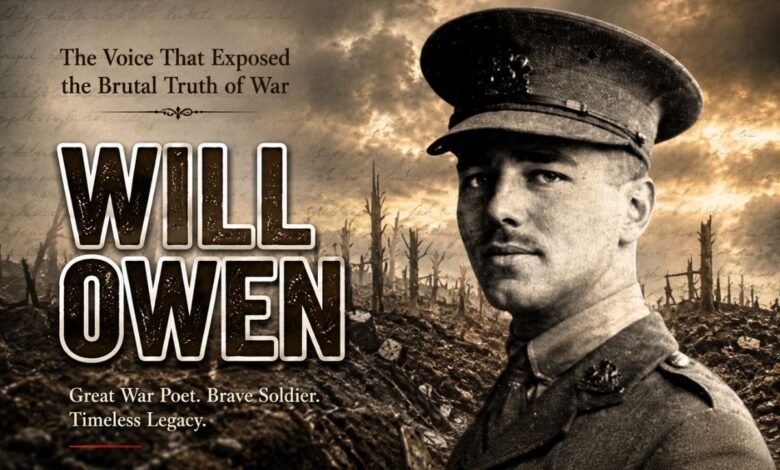
Will Owen: The Legendary War Poet Who Revealed the Brutal Truth of World War I
Introduction
Will Owen, better known as Wilfred Owen, remains one of the most influential war poets in literary history. His poetry changed how the world viewed war by exposing the horrifying realities faced by soldiers during World War I. Unlike many writers of his era who celebrated patriotism and heroism, Owen focused on fear, suffering, trauma, and death on the battlefield. His emotional and deeply realistic poems continue to inspire readers, students, and historians across the globe.
Although his life was tragically short, his literary legacy has survived for more than a century. His poetry not only documented the horrors of war but also challenged governments and societies that glorified violence and sacrifice. Today, Will Owen is remembered as a fearless literary voice who gave humanity a truthful picture of war.
Quick Info About Will Owen
Full Name
Wilfred Edward Salter Owen
Popular Name
Will Owen
Born
March 18, 1893
Birthplace
Oswestry, Shropshire, England
Profession
Poet and Soldier
Famous For
World War I Poetry
Nationality
British
Died
November 4, 1918
Age at Death
25 Years Old
Most Famous Poems
Dulce et Decorum Est, Anthem for Doomed Youth, Exposure, Strange Meeting
Early Life and Childhood
Family Background
Will Owen was born into a middle-class English family. His parents, Tom Owen and Susan Owen, valued education and religion. During his childhood, the family moved several times because of financial difficulties. Despite these struggles, Owen developed a strong interest in literature and poetry from an early age.
Education and Literary Interests
Owen attended schools in Birkenhead and Shrewsbury. He loved reading poetry and admired famous Romantic poets such as John Keats and Percy Bysshe Shelley. Their influence can be seen in the emotional beauty and descriptive language found in his early writings.
As a teenager, Owen dreamed of becoming a respected poet. Before joining the military, he worked as a teacher and tutor in France, where he improved his language skills and expanded his cultural understanding.
Will Owen and World War I
Joining the British Army
In 1915, during World War I, Owen enlisted in the British Army. Like many young men of his generation, he initially believed serving his country was an honorable duty. However, his experiences on the front lines quickly destroyed those idealistic beliefs.
Life in the Trenches
The trenches of World War I were extremely dangerous and miserable. Soldiers faced mud, freezing weather, disease, explosions, hunger, and constant fear of death. Owen witnessed injured soldiers, deadly gas attacks, and psychological trauma that permanently affected thousands of men.
His experiences deeply changed him as both a soldier and a writer. Instead of writing patriotic poems, he began describing the painful realities of war with honesty and compassion.
Shell Shock and Recovery
During his military service, Owen suffered from shell shock, a condition now recognized as post-traumatic stress disorder. He was sent to Craiglockhart War Hospital in Scotland for treatment. This period became one of the most important stages of his literary career.
Friendship with Siegfried Sassoon
Meeting a Literary Mentor
At Craiglockhart Hospital, Owen met the famous war poet Siegfried Sassoon. Sassoon encouraged Owen to write truthfully about war and helped improve his poetic style. Their friendship greatly influenced Owen’s development as a writer.
Sassoon believed poetry should expose the horrors of battle rather than glorify it. Owen adopted this philosophy and began producing the powerful poems that later made him world famous.
Growth as a Poet
Under Sassoon’s guidance, Owen refined his use of imagery, sound, rhythm, and emotional storytelling. During this time, he wrote several masterpieces that are still studied in schools and universities today.
Famous Poems by Will Owen
Dulce et Decorum Est
This poem is considered Owen’s greatest work. It describes exhausted soldiers struggling through mud before a sudden poison gas attack kills one of them in horrifying fashion.
The poem attacks the false idea that dying for one’s country is glorious. Owen called this patriotic message “the old Lie,” making the poem one of the strongest anti-war statements ever written.
Anthem for Doomed Youth
This poem compares soldiers dying in battle to animals being slaughtered. Instead of peaceful funerals and prayers, the soldiers receive only the sounds of guns and explosions.
The poem highlights the tragic waste of young lives during war.
Exposure
In Exposure, Owen describes soldiers trapped in freezing trenches while constantly waiting for death. The poem focuses on fear, exhaustion, loneliness, and hopelessness.
Strange Meeting
This emotional poem imagines two dead soldiers meeting in the afterlife. One soldier reveals he was killed by the other during battle. The poem explores guilt, forgiveness, and the shared suffering of humanity.
Themes in Will Owen’s Poetry
The Horror of War
Owen showed war as terrifying and cruel rather than heroic. His poems reveal the physical and emotional destruction caused by combat.
Human Suffering
He focused on ordinary soldiers and their pain, fear, and trauma. His compassion for soldiers made his poetry deeply emotional and relatable.
Anti-War Message
Owen criticized governments and propaganda that encouraged young men to fight without understanding war’s brutal realities.
Loss of Innocence
Many of Owen’s poems show how war destroys youth, dreams, and innocence.
Writing Style and Literary Techniques
Powerful Imagery
Owen used vivid descriptions to make readers feel the horrors of battle. His poetry often includes graphic details of wounds, gas attacks, and suffering.
Emotional Realism
His work feels authentic because it was based on personal experience. Readers can sense the fear and exhaustion faced by soldiers.
Use of Sound and Rhythm
Owen carefully used rhythm, repetition, and half-rhymes to create emotional intensity in his poetry.
Combination of Beauty and Horror
One of Owen’s greatest strengths was his ability to combine beautiful poetic language with disturbing war imagery.
Death of Will Owen
Final Days of War
In 1918, Owen returned to the battlefield despite his traumatic experiences. On November 4, 1918, he was killed while leading soldiers across the Sambre-Oise Canal in France.
Tragically, he died just one week before World War I officially ended.
National Mourning
Owen’s family reportedly received news of his death as church bells rang across Britain to celebrate peace. This heartbreaking coincidence became one of the most tragic moments connected to World War I literature.
Legacy and Influence
Publication After Death
Most of Owen’s poems were published after his death with the support of Siegfried Sassoon and literary editors. His work quickly gained recognition for its honesty and emotional power.
Influence on Literature
Will Owen transformed war poetry forever. His realistic approach inspired future generations of poets, writers, filmmakers, and historians.
Educational Importance
Today, his poems are widely taught in schools and universities around the world. Students study his work to understand both literature and the human cost of war.
Cultural Impact
Owen’s poetry remains relevant because war and conflict still affect millions of lives globally. His work continues to remind humanity about the importance of peace and compassion.
FAQs About Will Owen
Who was Will Owen?
Will Owen, officially known as Wilfred Owen, was an English poet and soldier famous for his World War I poetry.
Why is Will Owen famous?
He became famous for writing realistic and emotional poems about the horrors of war.
What is Will Owen’s most famous poem?
His most famous poem is Dulce et Decorum Est.
Did Will Owen fight in World War I?
Yes, he served as a British soldier during World War I.
How did Will Owen die?
He was killed in action in France on November 4, 1918.
What themes did Owen write about?
His poetry focused on war, suffering, fear, trauma, death, and the loss of innocence.
Why is Owen considered important today?
His poems continue to educate people about the emotional and physical realities of war.
Conclusion
Will Owen remains one of the greatest literary voices of the twentieth century. Through his deeply emotional and realistic poetry, he revealed the painful truths hidden behind patriotic slogans and military glory. His work gave a voice to soldiers who suffered in silence and transformed the world’s understanding of war.