david worrall: The Visionary Composer Blending Sound, Science, and Technology
Introduction
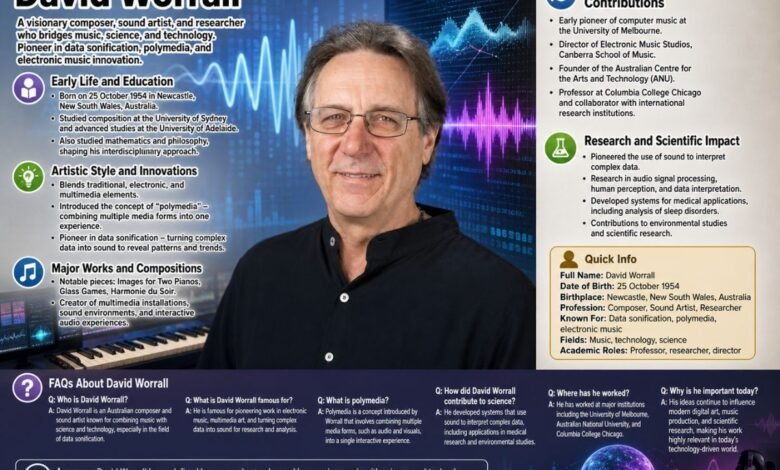
David Worrall is a name that stands out in the world of contemporary music and digital innovation. Born on 25 October 1954 in Newcastle, Australia, he has built a remarkable career that crosses the boundaries of music, science, and technology. Unlike traditional composers, Worrall has explored sound not just as art, but as a powerful tool for understanding complex systems and data.
His work has influenced fields ranging from electroacoustic composition to scientific research, making him one of the most versatile creative minds of his generation.
Early Life and Education
Childhood and Background
David Worrall grew up in Newcastle, New South Wales, a region known for its industrial landscape and cultural diversity. This environment played a subtle role in shaping his curiosity about sound, structure, and patterns.
From an early age, he showed a strong interest in both music and analytical thinking. This combination later became the foundation of his interdisciplinary career.
Academic Journey
Worrall pursued his studies in:
- Composition at the University of Sydney
- Advanced studies at the University of Adelaide
- Mathematics and philosophy
This unique academic mix allowed him to approach music differently. Instead of focusing only on melody and harmony, he began exploring how sound interacts with logic, data, and perception.
Career Beginnings
Entry into Music and Technology
In the late 1970s, Worrall joined the University of Melbourne, where he became involved in early developments in computer music. At a time when digital sound was still emerging, he was already experimenting with new ways to create and manipulate audio.
Pioneering Computer Music
He quickly became a pioneer in:
- Digital sound synthesis
- Electronic composition
- Computer-assisted music creation
His early work helped lay the groundwork for modern electronic music practices, especially in academic and experimental settings.
Artistic Style and Innovations
What Makes His Work Unique
David Worrall is not limited to one style or genre. His work blends:
- Traditional instrumental music
- Electronic and digital sound
- Visual and multimedia elements
He introduced the concept of “polymedia”, which refers to combining multiple forms of media into a single artistic experience. This idea was ahead of its time and is now widely used in digital art and interactive installations.
Sound as Data
One of his most important contributions is in data sonification.
What is Data Sonification?
Data sonification is the process of turning data into sound. Instead of reading numbers or graphs, listeners can “hear” patterns and trends.
Worrall used this technique in areas like:
- Scientific research
- Medical diagnostics
- Environmental studies
This approach allows complex data to become more accessible and intuitive.
Major Works and Compositions
Notable Pieces
David Worrall has created a wide range of compositions, including:
- Images for Two Pianos
- Glass Games
- Harmonie du Soir
These works demonstrate his ability to merge classical structure with modern experimentation.
Multimedia Installations
Beyond traditional compositions, he has also developed:
- Sound installations
- Interactive audio environments
- Immersive multimedia experiences
These projects often engage audiences in a more direct and sensory way, transforming listeners into participants.
Academic and Professional Contributions
Leadership in Education
Worrall has held several influential academic roles:
- University of Melbourne – early work in computer music
- Canberra School of Music – Director of Electronic Music Studios
- Australian National University – Founder of the Australian Centre for the Arts and Technology
His contributions have shaped how music and technology are taught in universities.
International Work
He has also worked internationally, including collaborations with research institutions in Europe. His role as a professor at Columbia College Chicago further expanded his influence on global music education.
Research and Scientific Impact
Bridging Art and Science
Worrall’s work goes beyond music into scientific research. He has contributed to projects involving:
- Audio signal processing
- Human perception of sound
- Data interpretation through audio
Medical Applications
One of his most fascinating contributions is in healthcare. He has worked on systems that use sound to help analyze medical conditions such as sleep disorders.
This demonstrates how artistic knowledge can be applied to real-world problems.
Influence and Legacy
Impact on Modern Music
David Worrall’s influence can be seen in:
- Electronic music production
- Sound design for media
- Interactive digital art
Many modern artists and researchers build on ideas he helped develop decades ago.
Inspiring Future Generations
His interdisciplinary approach encourages students and professionals to think beyond traditional boundaries. By combining creativity with scientific thinking, he has opened new pathways for innovation.
Personal Philosophy
A Different Way of Thinking
Worrall believes that sound is more than entertainment. For him, it is:
- A tool for exploration
- A method of communication
- A bridge between disciplines
This philosophy has guided his career and continues to inspire others.
Quick Info About David Worrall
- Full Name: David Worrall
- Date of Birth: 25 October 1954
- Birthplace: Newcastle, New South Wales, Australia
- Profession: Composer, Sound Artist, Researcher
- Known For: Data sonification, polymedia, electronic music
- Fields: Music, technology, science
- Academic Roles: Professor, researcher, director
FAQs About David Worrall
Who is David Worrall?
David Worrall is an Australian composer and sound artist known for combining music with science and technology, especially in the field of data sonification.
What is David Worrall famous for?
He is famous for pioneering work in electronic music, multimedia art, and turning complex data into sound for research and analysis.
What is polymedia?
Polymedia is a concept introduced by Worrall that involves combining multiple media forms, such as audio and visuals, into a single interactive experience.
How did David Worrall contribute to science?
He developed systems that use sound to interpret complex data, including applications in medical research and environmental studies.
Where has he worked?
He has worked at major institutions including the University of Melbourne, Australian National University, and Columbia College Chicago.
Why is he important today?
His ideas continue to influence modern digital art, music production, and scientific research, making his work highly relevant in today’s technology-driven world.
Conclusion
David Worrall is not just a composer; he is a visionary who has redefined how we understand sound. By merging music with science and technology, he has created a legacy that continues to shape multiple disciplines.